
 Image 1 of 1
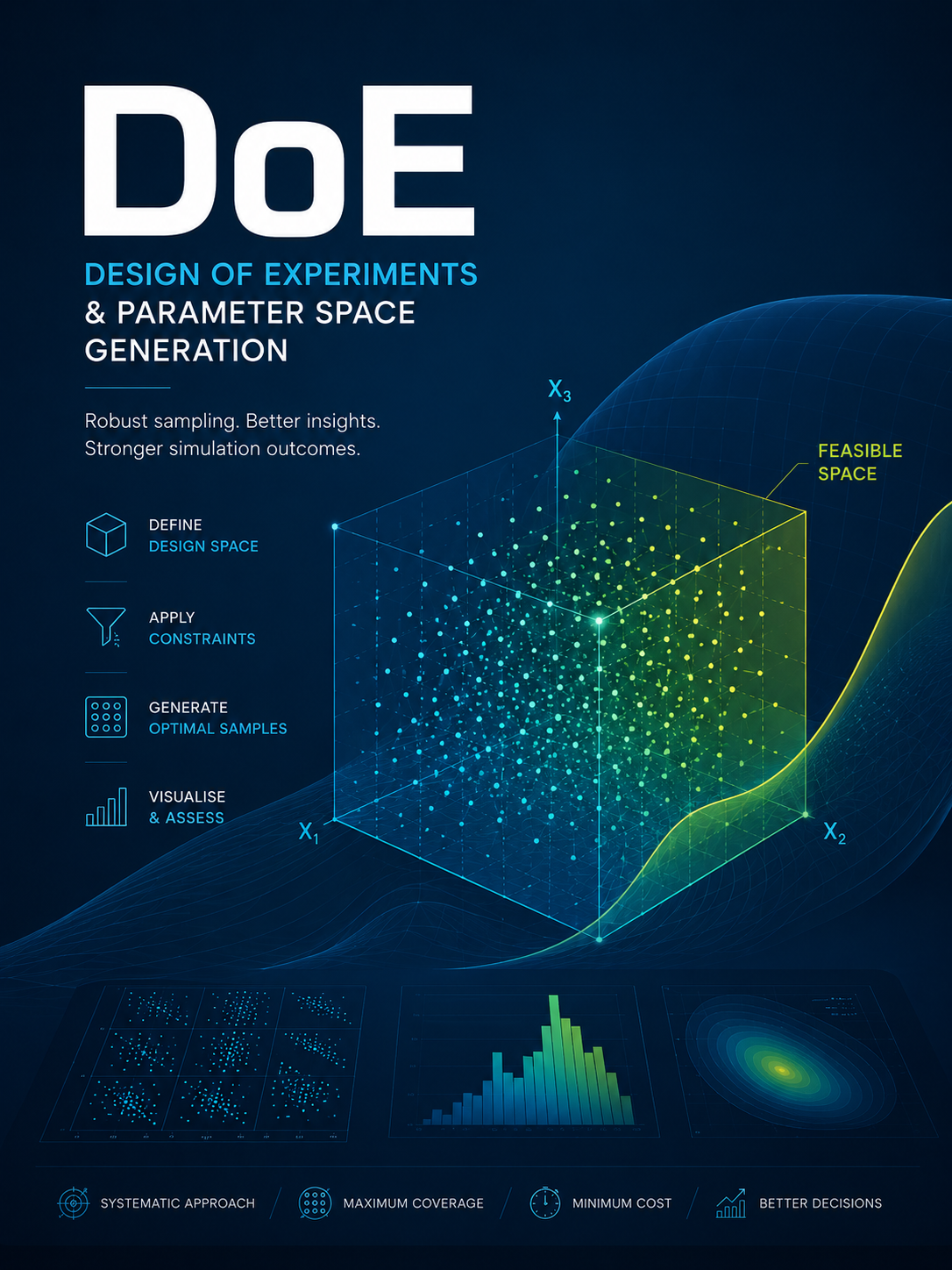
Design of Experiments (DoE) & Parameter Space Generation for Numerical Simulations
Build a Robust Foundation for Simulation-Driven Engineering
Successful numerical investigations begin with a well-defined design space. Before running computationally expensive simulations, it is essential to understand which input parameters influence the problem, how they interact, and how the parameter space should be sampled to achieve meaningful and comprehensive results.
Our Design of Experiments (DoE) service provides a systematic framework for generating high-quality simulation input datasets that maximize coverage of the physical and numerical design space while minimizing redundancy and computational cost.
What We Do
We develop a complete parameter exploration strategy based on:
Definition of input parameters
Parameter ranges and operating limits
Resolution and increment specification
Variable dependencies and correlations
Mathematical and physical constraints
Feasibility filtering
Sampling strategy selection
Typical constraints may include:
Geometric limitations
Material property relationships
Manufacturing restrictions
Physical feasibility conditions
User-defined equations and inequalities
Examples:
X₁ + X₂ × X₃ < 50
Stress < Yield Strength
Thickness / Diameter ≥ 0.05
Only physically and mathematically valid design points are retained within the final sampling space.
Advanced Sampling Strategies
Once the design space is defined, our proprietary Python-based framework generates the sample set using the most suitable strategy for the problem:
Full Factorial / Grid Sampling
Latin Hypercube Sampling (LHS)
Stratified Sampling
Random Sampling
Custom Hybrid Approaches
The selected method is chosen to maximize parameter-space coverage while maintaining computational efficiency.
Deliverables
Every project includes a comprehensive Design Space Report containing:
Parameter definitions and limits
Constraint documentation
Sampling methodology
Pairwise scatter plots
Correlation visualizations
Histograms of parameter distributions
Coverage and density assessments
Sample-space quality evaluation
These visualizations provide a clear understanding of how the generated samples populate the design domain before any simulations are executed.
Why Is This Important?
A common issue in simulation studies is the investigation of only a limited region of the design space. This can lead to:
Missed critical behaviours
Hidden parameter interactions
Incomplete sensitivity assessments
Biased conclusions
Inefficient computational expenditure
A structured Design of Experiments approach ensures that the investigation begins with a statistically sound and physically representative sample set.
Benefits include:
Improved design-space coverage
Increased confidence in simulation outcomes
Better sensitivity and optimisation studies
Reduced risk of overlooking critical regions
More efficient use of computational resources
Stronger foundations for surrogate modelling, optimisation and machine learning workflows
Applications
Our primary expertise is in:
Mechanical Engineering
Structural Engineering
Finite Element Analysis (FEA)
Computational Mechanics
Multiphysics Simulations
Design Optimisation Studies
However, our methodology is applicable to any numerical modelling or simulation-based investigation. If your application falls outside these areas, our team will be happy to discuss its suitability.
Request a Quotation
Every project is unique.
Contact our enquiry team to discuss your problem, define the required design space, and receive a tailored quotation for your study.
Build a Robust Foundation for Simulation-Driven Engineering
Successful numerical investigations begin with a well-defined design space. Before running computationally expensive simulations, it is essential to understand which input parameters influence the problem, how they interact, and how the parameter space should be sampled to achieve meaningful and comprehensive results.
Our Design of Experiments (DoE) service provides a systematic framework for generating high-quality simulation input datasets that maximize coverage of the physical and numerical design space while minimizing redundancy and computational cost.
What We Do
We develop a complete parameter exploration strategy based on:
Definition of input parameters
Parameter ranges and operating limits
Resolution and increment specification
Variable dependencies and correlations
Mathematical and physical constraints
Feasibility filtering
Sampling strategy selection
Typical constraints may include:
Geometric limitations
Material property relationships
Manufacturing restrictions
Physical feasibility conditions
User-defined equations and inequalities
Examples:
X₁ + X₂ × X₃ < 50
Stress < Yield Strength
Thickness / Diameter ≥ 0.05
Only physically and mathematically valid design points are retained within the final sampling space.
Advanced Sampling Strategies
Once the design space is defined, our proprietary Python-based framework generates the sample set using the most suitable strategy for the problem:
Full Factorial / Grid Sampling
Latin Hypercube Sampling (LHS)
Stratified Sampling
Random Sampling
Custom Hybrid Approaches
The selected method is chosen to maximize parameter-space coverage while maintaining computational efficiency.
Deliverables
Every project includes a comprehensive Design Space Report containing:
Parameter definitions and limits
Constraint documentation
Sampling methodology
Pairwise scatter plots
Correlation visualizations
Histograms of parameter distributions
Coverage and density assessments
Sample-space quality evaluation
These visualizations provide a clear understanding of how the generated samples populate the design domain before any simulations are executed.
Why Is This Important?
A common issue in simulation studies is the investigation of only a limited region of the design space. This can lead to:
Missed critical behaviours
Hidden parameter interactions
Incomplete sensitivity assessments
Biased conclusions
Inefficient computational expenditure
A structured Design of Experiments approach ensures that the investigation begins with a statistically sound and physically representative sample set.
Benefits include:
Improved design-space coverage
Increased confidence in simulation outcomes
Better sensitivity and optimisation studies
Reduced risk of overlooking critical regions
More efficient use of computational resources
Stronger foundations for surrogate modelling, optimisation and machine learning workflows
Applications
Our primary expertise is in:
Mechanical Engineering
Structural Engineering
Finite Element Analysis (FEA)
Computational Mechanics
Multiphysics Simulations
Design Optimisation Studies
However, our methodology is applicable to any numerical modelling or simulation-based investigation. If your application falls outside these areas, our team will be happy to discuss its suitability.
Request a Quotation
Every project is unique.
Contact our enquiry team to discuss your problem, define the required design space, and receive a tailored quotation for your study.